Patek philippe Nautilus | Evolution: 3700 to 5811 Ultimate
Feeling lost in the world of Nautilus watches? You’re not alone. “What really changed from the 5711 to the 5811?”—it’s a question every collector asks at least once. The Nautilus isn’t just a watch; it’s a piece of history, born in 1976 as Patek Philippe’s bold answer to a changing world. From its porthole-inspired design to its rise as the ultimate luxury sports watch, the Nautilus has captivated both newcomers and seasoned collectors alike. In this guide, we’ll explore its full evolution, uncover the subtle changes that make each model unique, and reveal why this timepiece continues to define style, prestige, and innovation.
By the end, you’ll see the Nautilus like never before—and maybe even spot which one deserves a place on your wrist.
To see how this legendary design evolved over time, explore our Complete history of the Patek Philippe Nautilus, covering every major reference, complication, and milestone that shaped this iconic watch.
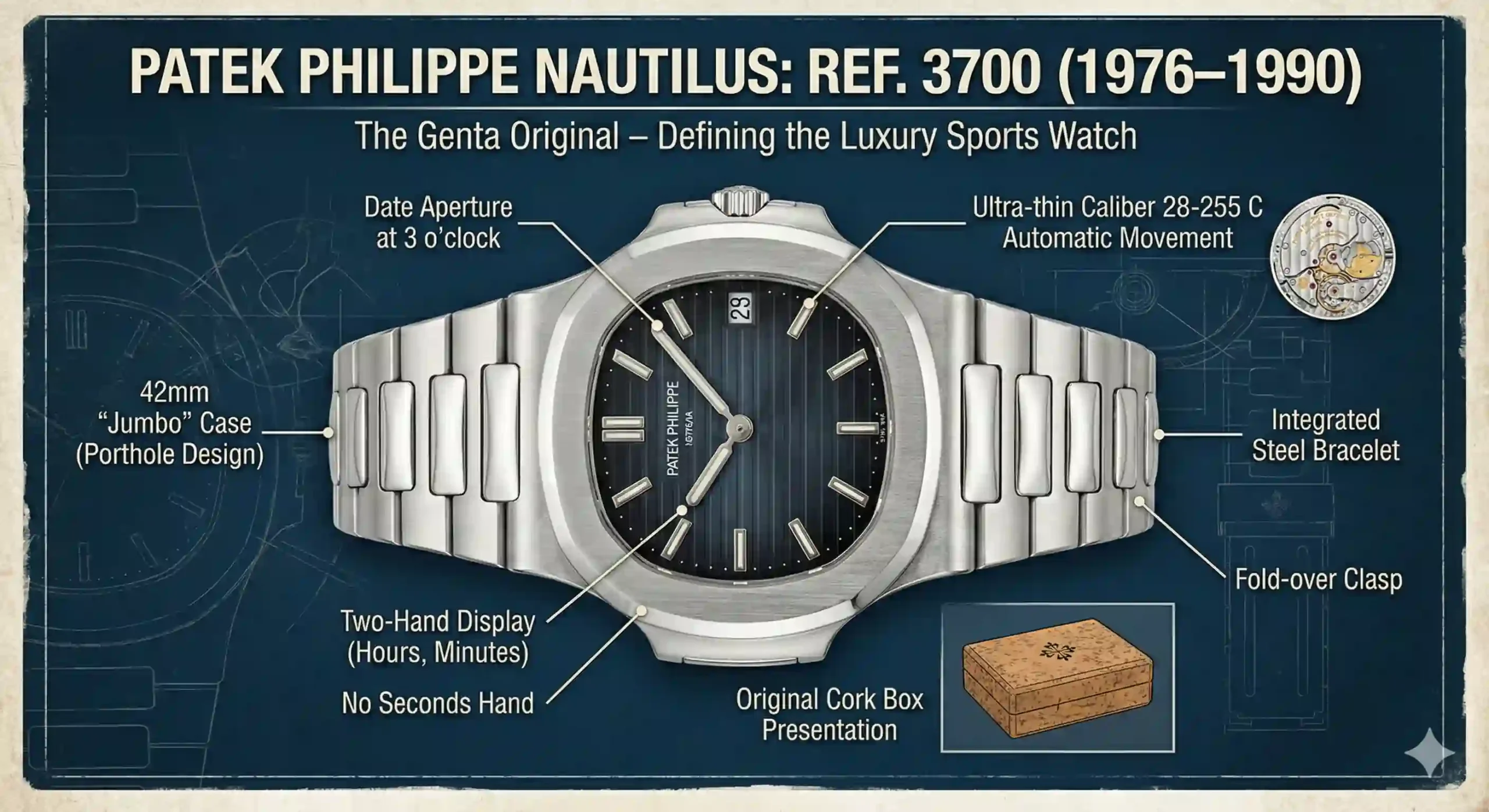
Legacy and Influence of the Nautilus 3700
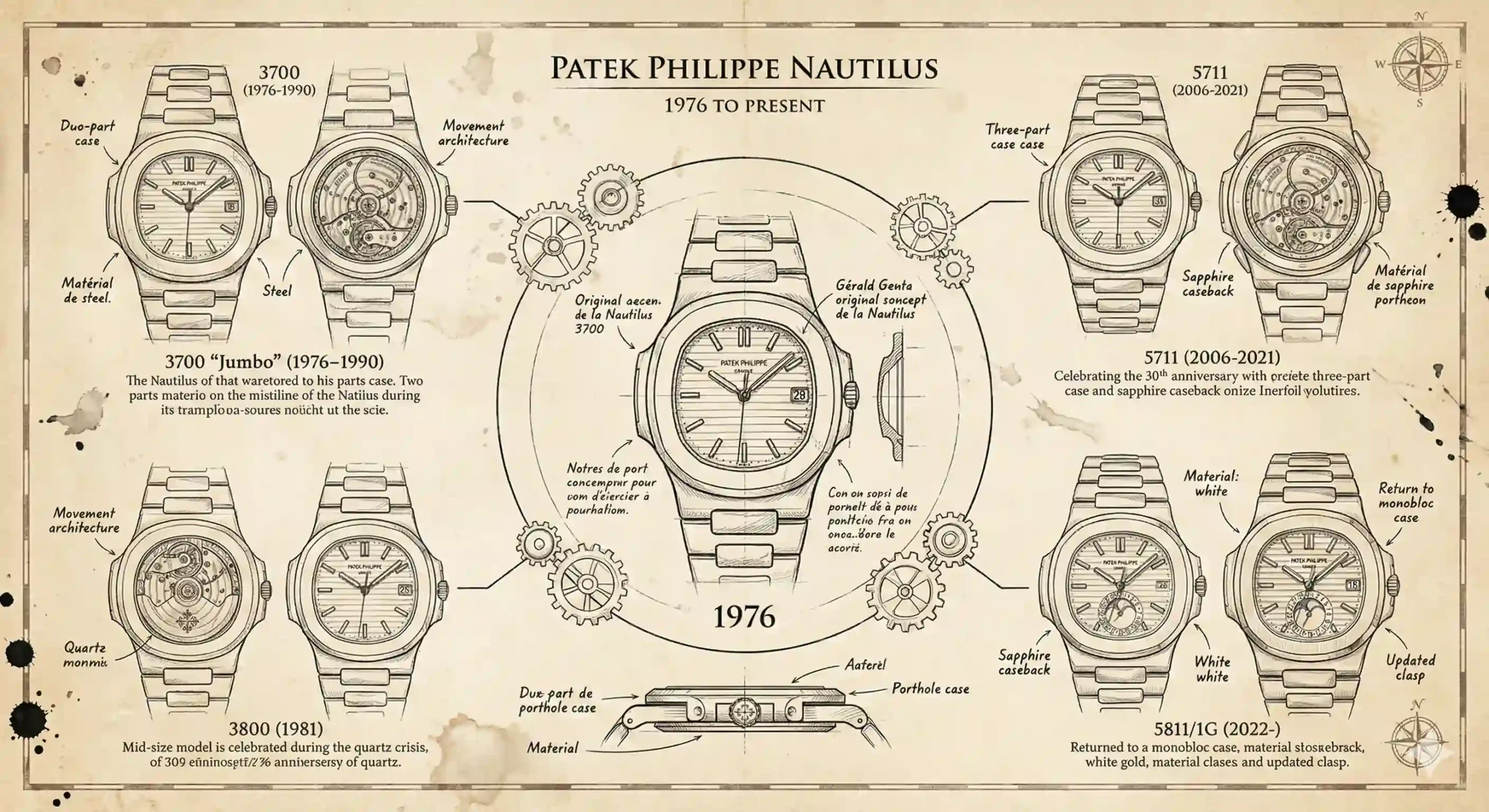
Imagine this: 1976, a daring idea, and a watch that would rewrite the rules of luxury. The Patek Philippe Nautilus Ref. 3700, nicknamed the “Jumbo,” wasn’t just another timepiece—it was a bold steel sports watch in a world of gold. Designed by the legendary Gérald Genta in just five minutes, its rounded-octagon bezel and porthole-inspired case instantly stood out. Slim yet robust, water-resistant yet elegant, with a bracelet that flowed seamlessly into the case, it redefined what a luxury watch could be. Collectors still marvel at the ribbed blue dial, the ultra-thin calibre 28-255 movement, and the subtle evolution across its series. Curious about how this audacious design sparked a legacy that continues with the 5811? Let’s dive in—you’re about to see why the Nautilus remains a grail watch decades later.
Introduced the Midsize Nautilus 3800 (1981-2006)
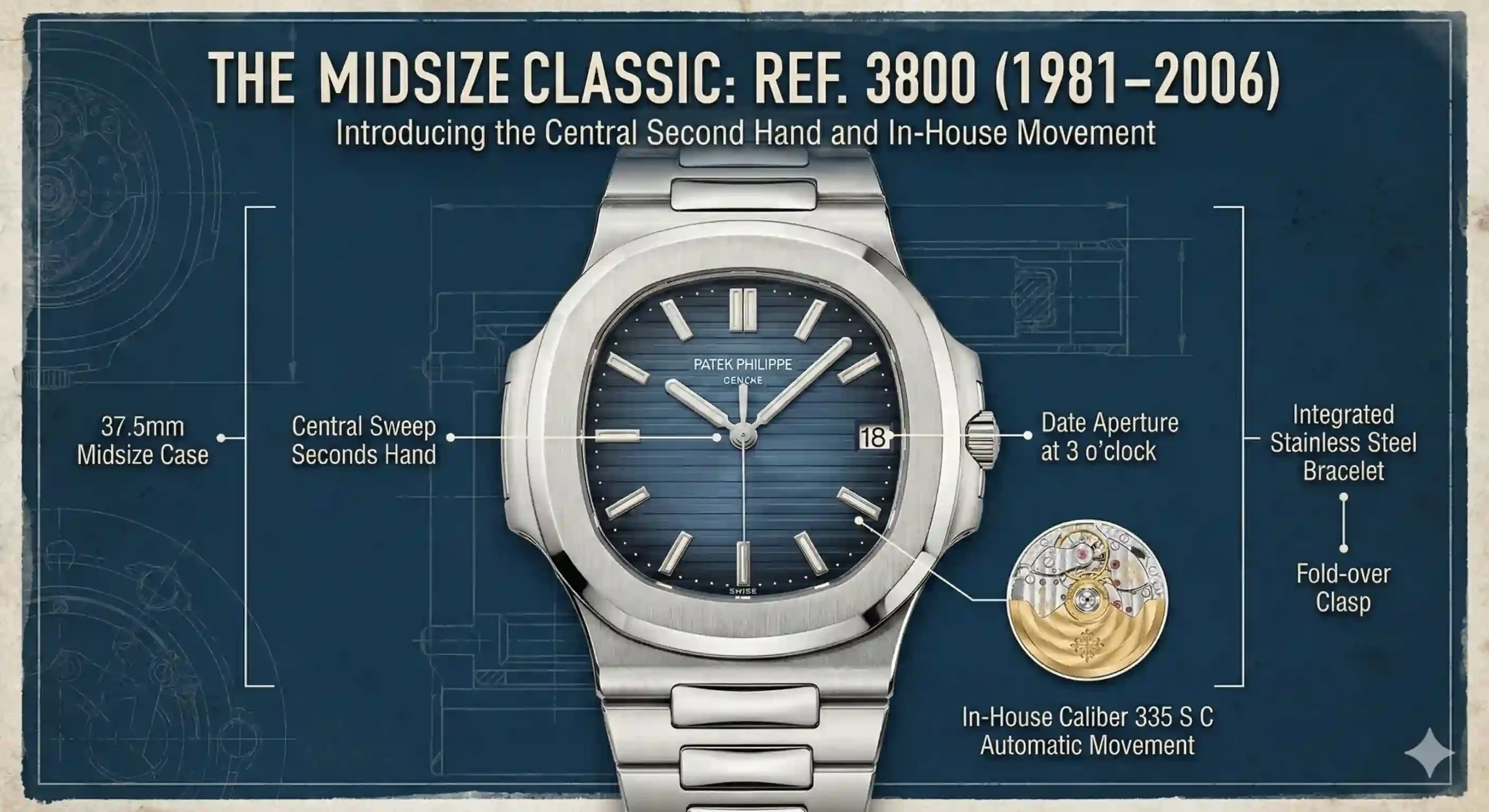
Not everyone loved the original 42mm “Jumbo” Nautilus, so Patek Philippe got creative. In 1981, they introduced the mid-size Ref. 3800, measuring a more modest 37.5mm—perfect for smaller wrists but still packed with the Nautilus charm. Under the hood, it featured a new in-house movement with central seconds, gradually upgraded over the years to include the prestigious Poinçon de Genève and Gyromax balance. The watch wasn’t just smaller; it opened the door to a wider audience, offering steel, two-tone, and even gold or platinum options. With the signature porthole case, integrated bracelet, and ribbed dial intact, the 3800 proved that bold design and versatility could coexist. Curious how this mid-size marvel carried the Nautilus legacy forward and paved the way for future icons like the 5711 and 5811? Let’s explore its story.
Reference 5060/SJ Marked a Turning Point for Patek Philippe
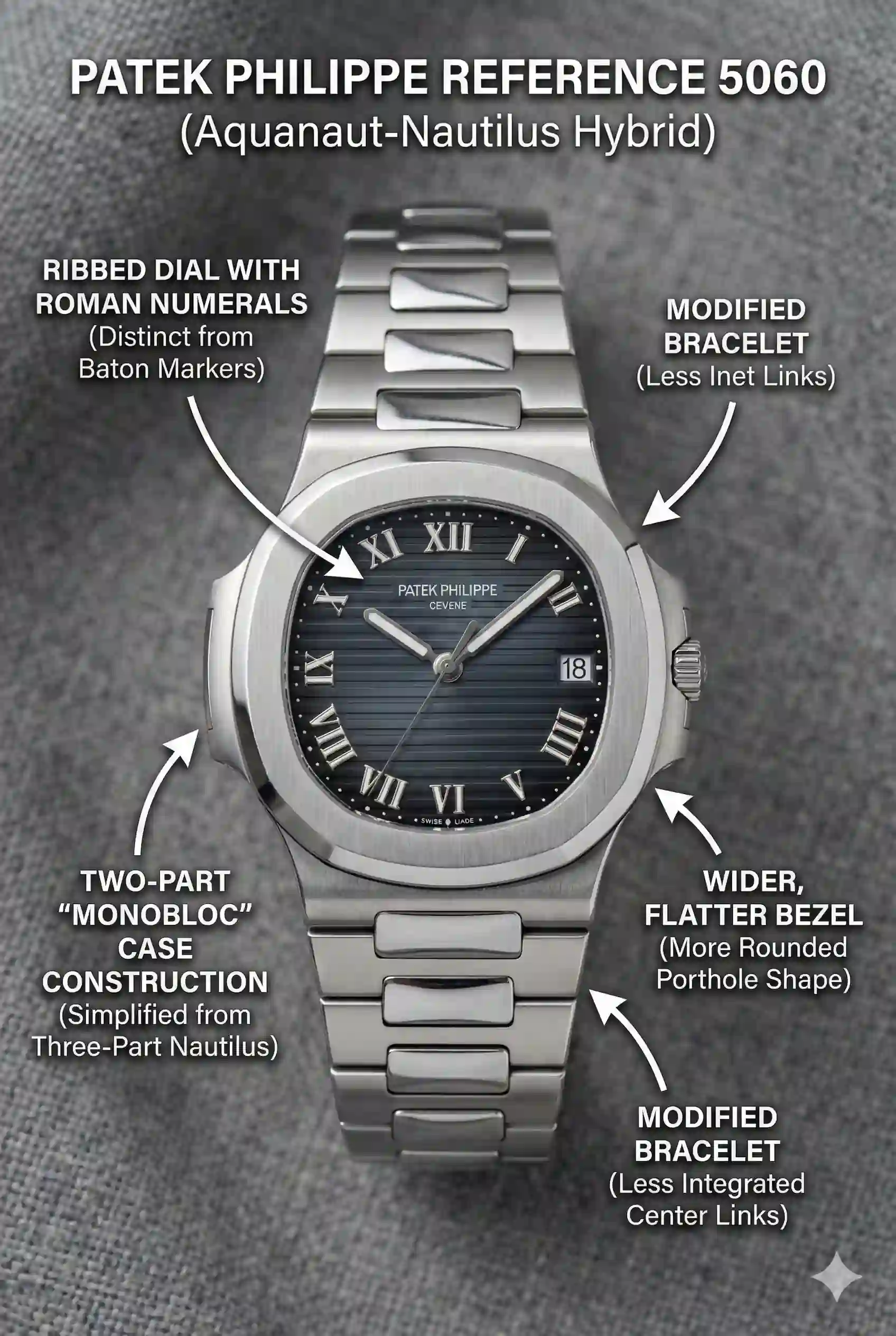
By 1996, the Nautilus had already evolved beyond its original “Jumbo” and mid-size models, yet Patek Philippe wasn’t done innovating. Enter the Ref. 5060/SJ—a bold reinterpretation bridging the Nautilus and the future Aquanaut. With a sleek 35mm yellow gold case, Roman numerals on a matte black dial, and a leather strap, it subtly nodded to tradition while hinting at what was next. Under the hood, it carried the same trusted caliber 330/194 SC from the latest 3800 models, linking past craftsmanship to future design. Collectors love it for its rarity and for marking the moment when the iconic Nautilus design language began to evolve into the modern Aquanaut. Curious how this transitional piece shaped the Nautilus legacy and inspired a whole new era of Patek sports watches? Let’s take a closer look.
Differences Between Nautilus 3710 and 3711 Explained
Return to Jumbo Size:
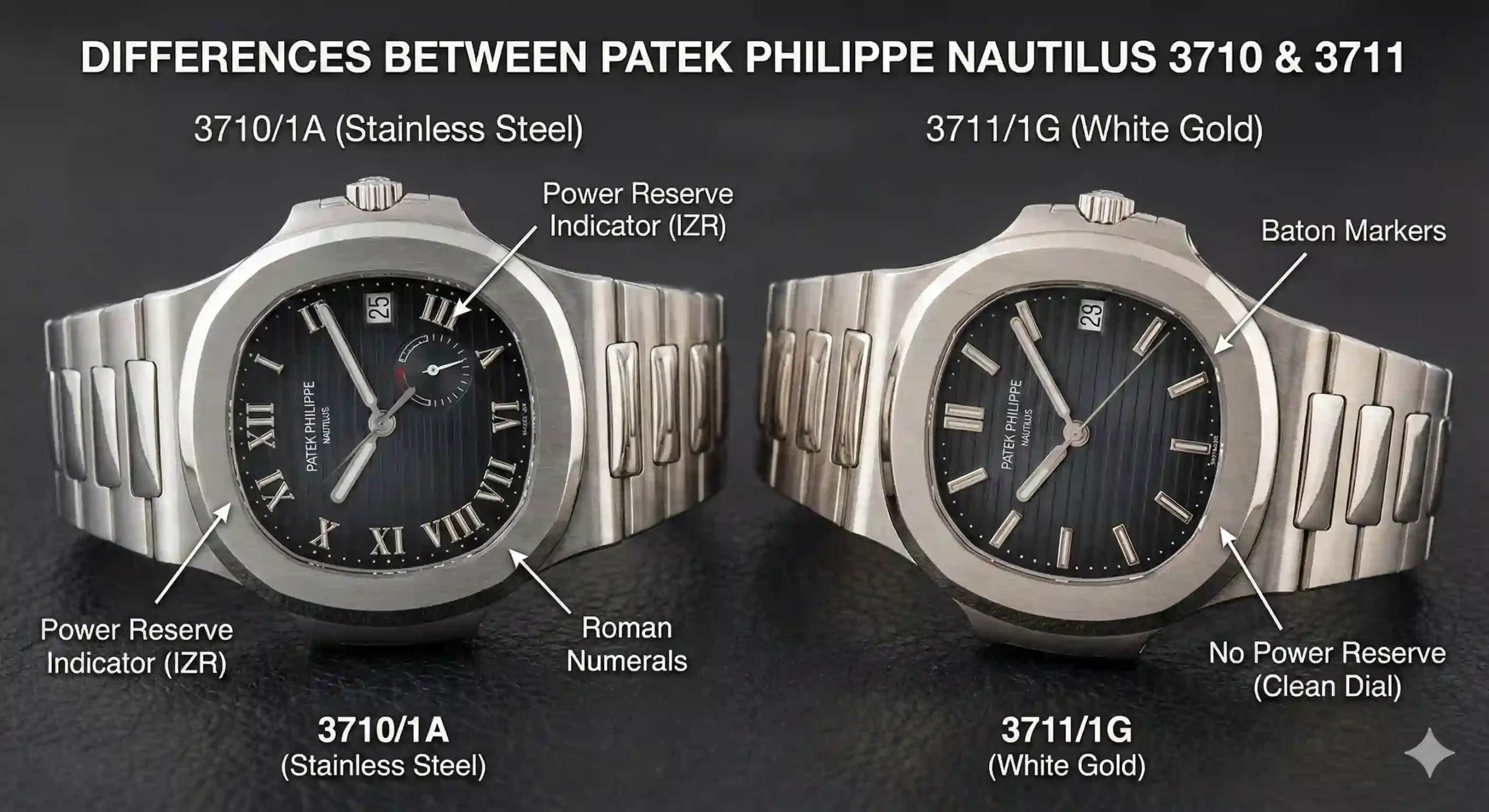
In 1998, Patek Philippe reintroduced the 42mm case with the Ref. 3710/1A, bringing back the iconic “Jumbo” proportions of the original 3700.
First Complication:
The 3710 was the first Nautilus to feature a power reserve indicator at 12 o’clock, adding a functional complication without compromising the elegant design.
The indicator rotates clockwise as the barrel winds and discharges, with a metallic graduated scale and pointer for precise reading.
Movement Innovations:
Powered by the caliber 330 S C IZR, an evolution of the 330/194 SC used in earlier 3800 and 5060 models.
Offers a 48-hour power reserve and runs at 3Hz.
Design & Dial:
Matte black dial with applied Roman numerals, continuing the aesthetic introduced in the 3800 series.
The asymmetrical placement of the power reserve gauge required moving the Patek Philippe logo lower on the dial.
Limited and Unique Editions:
A notable collector’s piece, the “Lucky Thirteen,” replaced the VIII numeral with XIII at the request of a superstitious owner, selling for CHF 254,600 at auction.
Standard models remain highly sought after, fetching USD 94,500 at Sotheby’s in 2022.
Nautilus 3711:
Produced from 2004 to 2006, it introduced a three-part case and a see-through case back, showcasing the Patek 315 SC automatic movement (an evolution of the 330).
Served as the foundation for the iconic 5711, which would dominate the Nautilus collection until 2021.
Significance:
The 3710 and 3711 mark a bridge between classic Nautilus designs and modern complications, blending heritage, functionality, and style.
They demonstrated how Patek Philippe could evolve the Nautilus while retaining its instantly recognizable DNA.
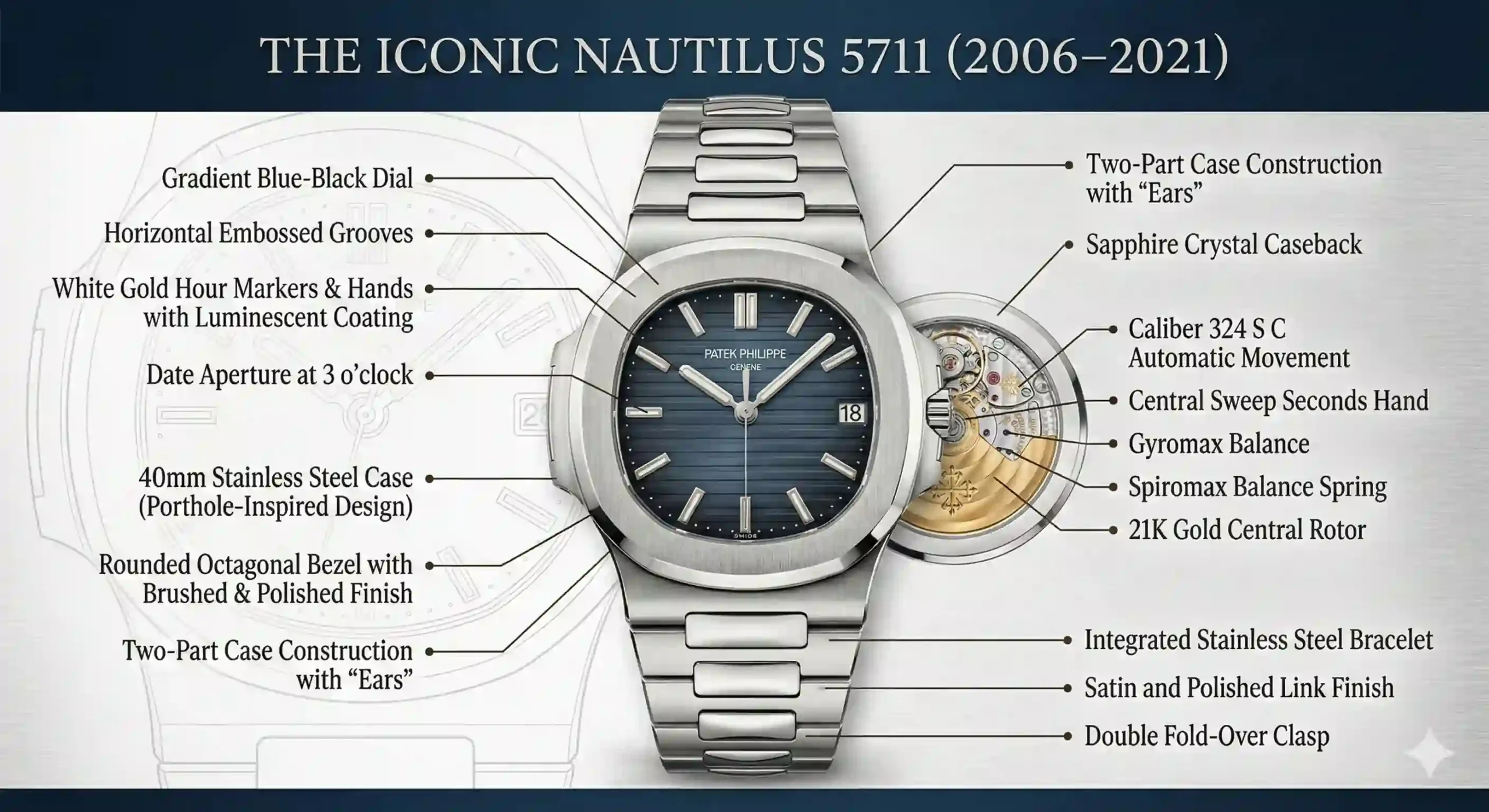
The Iconic Nautilus 5711 (2006–2021)
Return of the Jumbo:
Launched in 2006 to celebrate the Nautilus’ 30th anniversary, the Ref. 5711 reintroduced the “Jumbo” 42mm size with subtle refinements.
Slightly wider at 42.5mm ear-to-ear and 8.3mm thick, it retained the original Nautilus elegance while accommodating new movements.
Case & Dial Updates:
Three-part case construction with sapphire screw back, easing servicing while maintaining water resistance.
Blue dial featured a sunburst gradient, darker at the center fading to black at the edges.
Rounded baton hands and hour markers followed the bezel’s curvature, giving a more assertive look.
Bracelet updated with streamlined H-links and a double-folding clasp.
Movement Evolution:
2006–2007: Caliber 315 SC (self-winding)
2007–2019: Caliber 324 SC – introduced Gyromax balance, Spiromax hairspring, higher 4Hz frequency, improved wheel geometry, and low-friction pivots.
2019–2021: Caliber 26-330 SC – added hacking seconds and a nickel-phosphorus third wheel made using LIGA microfabrication for precision and reliability.
Material & Dial Variations:
Produced in stainless steel, all three shades of gold (leather strap), and platinum (limited or special request).
Experimental dial colors included white, brown, grey, green, and Tiffany Blue®.
Limited editions: green dial, baguette diamond bezel, and the Tiffany Blue® 170-piece commemorative edition (sold at over $6.5 million in auction).
Market Impact & Collector Status:
Upon discontinuation in 2021, the 5711 became the most sought-after Nautilus, with secondary market prices skyrocketing.
Widely considered a grail watch, its discontinuation sparked intense anticipation for the 2022 successor, Ref. 5811/1G.
Legacy:
The 5711 perfected the iconic Nautilus design codes: Jumbo case, integrated bracelet, ribbed dial, and elegant sportiness.
Cemented its status as a luxury sports watch benchmark alongside competitors like Audemars Piguet’s Royal Oak 15202ST.
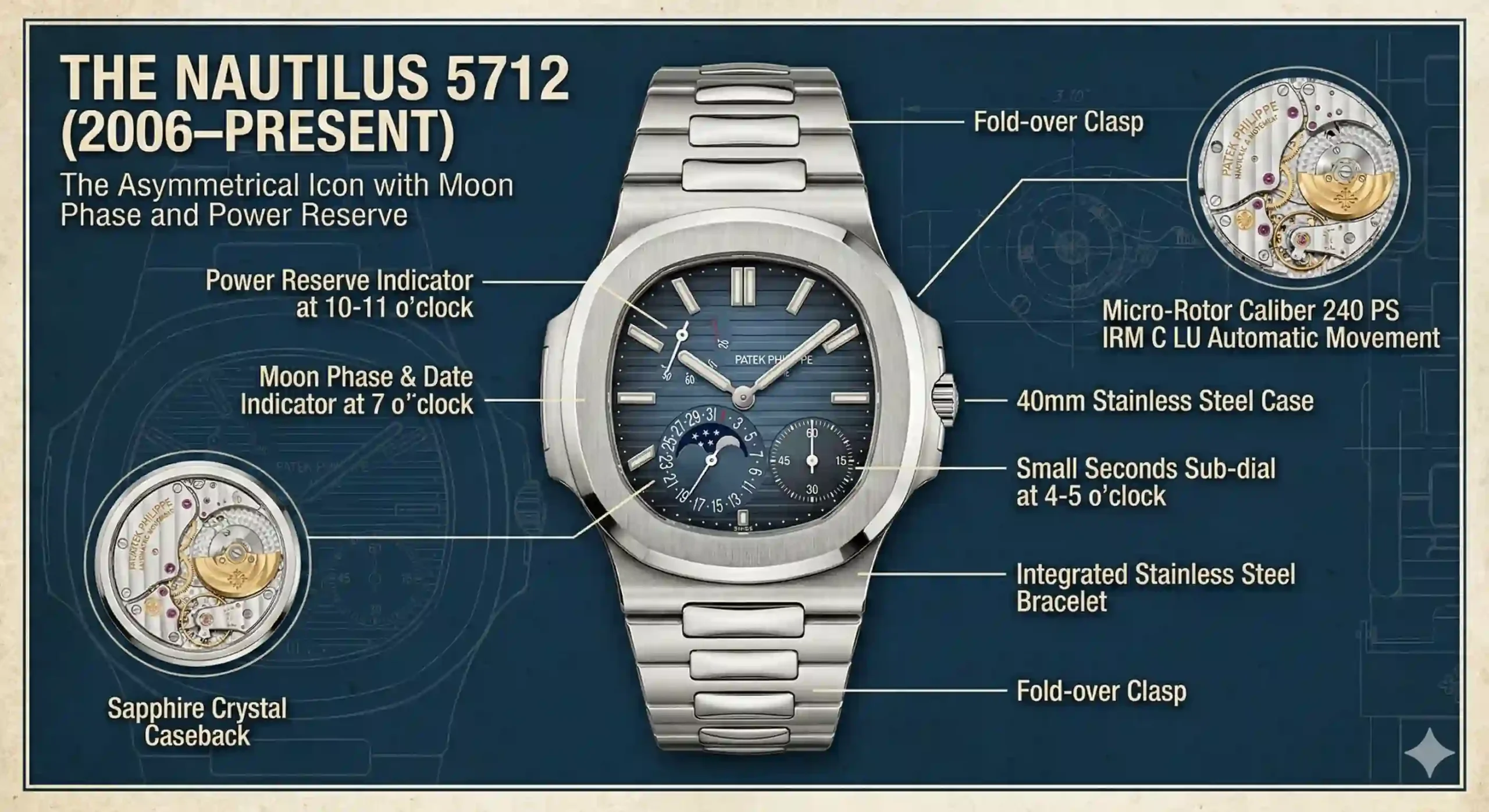
The Nautilus 5712 (2006–Present)
Launch & Relation to 5711:
Introduced alongside the 5711 in 2006, the Ref. 5712 succeeded the short-lived Ref. 3712.
Retains the same subtle refinements as the 5711: three-part case, 42.5mm diameter, gently curved “ears,” and blue gradient dial.
Complications & Movement:
Features date, power reserve, and moon phase indicators, making it a more complex alternative to the 5711.
Powered by caliber 240 PS IRM C LU, now bearing the Patek Philippe Seal.
Distinctive layout: small seconds sub-dial at 4 o’clock, with a crescent-shaped gear train due to the micro-rotor placement.
Materials & Variations:
Launched in steel and pink gold (brown gradient dial); pink gold model introduced the first integrated leather strap on a Nautilus.
Later versions included white gold and bi-colour white/rose gold models.
Special editions:
One-off titanium 5712 for Only Watch 2007, sold for EUR 525,000.
Tiffany-signed bimetal 5712GR, sold at USD 201,600 at Christie’s in 2023.
Significance:
Combines classic Nautilus design with functional elegance, offering collectors a more complex, visually dynamic timepiece.
Bridges the gap between sporty elegance and horological sophistication, appealing to both enthusiasts and seasoned collectors.
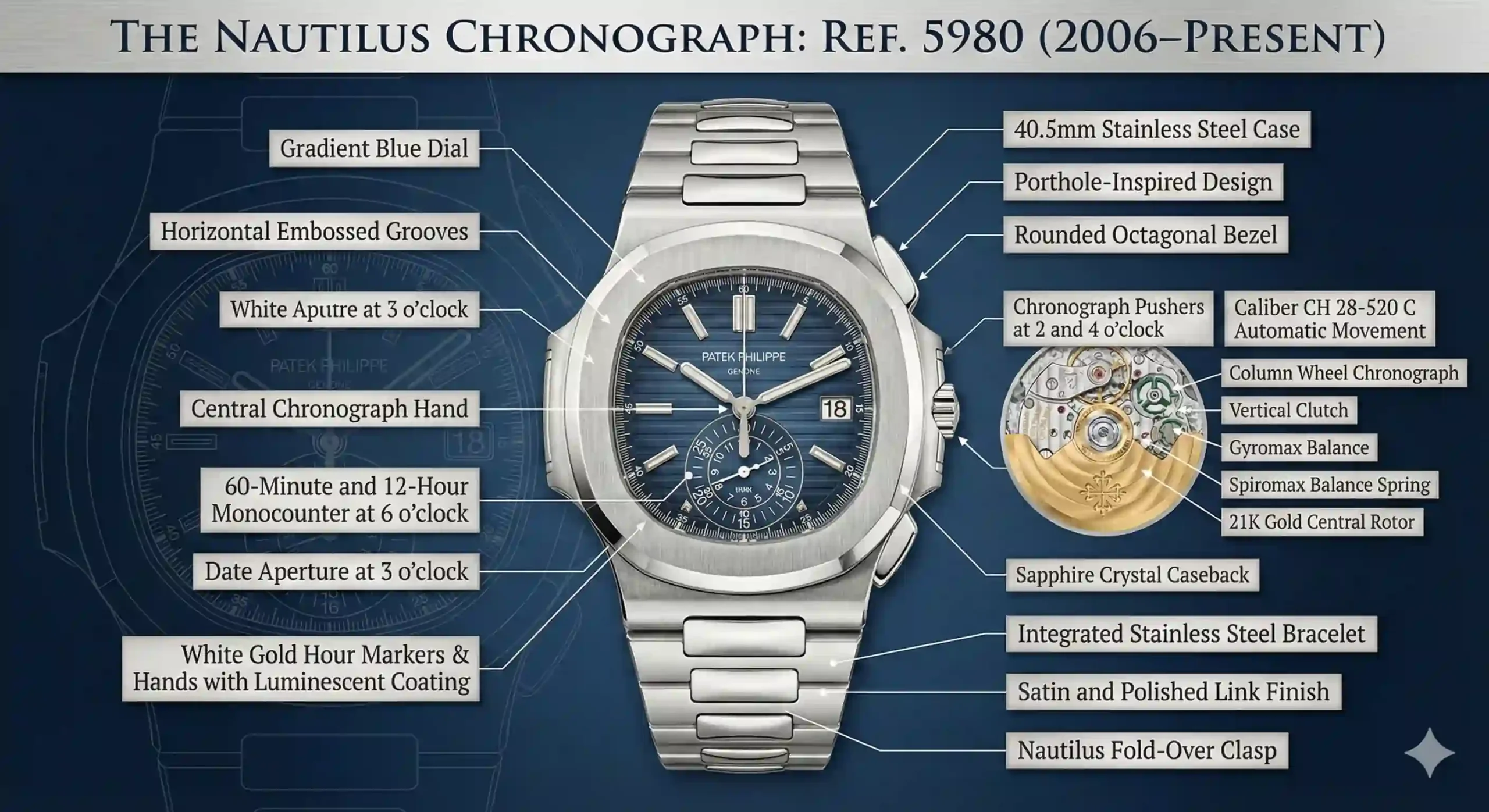
The Nautilus Chronograph: Ref. 5980 (2006–Present)
First Chronograph for Nautilus & Patek:
Launched in 2006, the Ref. 5980A was Patek Philippe’s first automatic chronograph and the first chronograph in the Nautilus line.
Case measures 40.2mm (10–4 o’clock) and 12.6mm thick, slightly thicker than standard Nautilus models but slimmer than most vertical-clutch chronographs.
Case & Construction:
Features a three-part case like the 5711, with lateral protrusions (“ears”) secured by four screws for enhanced robustness.
Maintains Nautilus design language while accommodating chronograph functionality.
Movement & Chronograph Functionality:
Powered by caliber 28-520 C flyback chronograph, 3Hz frequency, 45–55 hours power reserve.
Features a single elapsed minute counter with co-axial 12-hour scale at 6 o’clock; omits running seconds for slimmer movement.
Gear train optimized: fourth wheel integrated in vertical clutch, minimizing amplitude loss and wear, allowing chronograph seconds to run continuously without affecting timekeeping.
Third wheel drives motion works on the dial side, following modern Nautilus movement design principles.
Design & Dial Layout:
Streamlined, functional chronograph display without clutter; preserves signature Nautilus aesthetic.
Available in stainless steel and later variants, including rose gold/steel combination (Ref. 5980/1AR).
Significance:
Marked a major innovation for Nautilus: combining sporty elegance with high-end chronograph engineering.
Highly sought after by collectors for its technical sophistication and iconic design.
Overlooked Mid-Size: Short-lived Nautilus 5800 (2006–2009)
While the 5711, 5712, and 5980 stole the spotlight in 2006, Patek Philippe quietly launched the Ref. 5800, the successor to the popular mid-size 3800. Slightly larger at 38.5mm, it carried all the design upgrades of the era—gently rounded case ears and a blue gradient dial—but retained the trusted caliber 330 SC with Poinçon de Genève, likely to finish existing movement stock. Its monobloc case with integrated sapphire back, first seen in the 3712, was a subtle nod to modern Nautilus innovations.
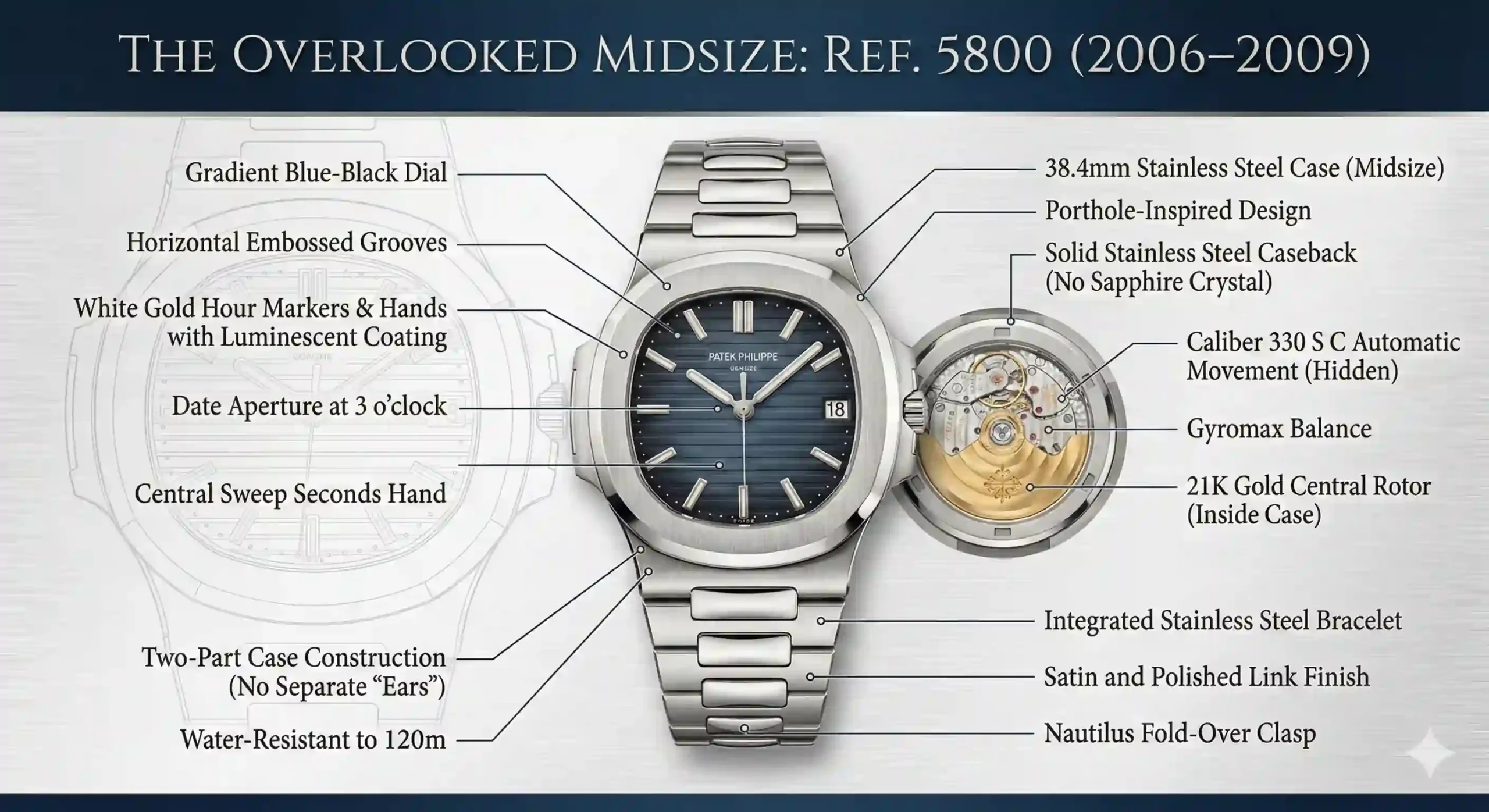
Despite its refined features, the market’s appetite for larger watches meant the 5800 was short-lived, discontinued in 2009. Yet today, its rarity and classical proportions make it a hidden gem for collectors, with examples selling at HK$1,071,000 (~CHF 137,290) at auction.
The Nautilus Annual Calendar: Ref. 5726 (2010–Present)
In 2010, Patek Philippe introduced the Ref. 5726, bringing the brand’s iconic annual calendar complication to the Nautilus line. Unlike traditional perpetual calendars, Patek’s annual calendar mechanism—first seen in the 1996 Ref. 5035—is simpler yet robust, relying on gears and pinions rather than a complex three-dimensional architecture, making it highly reliable.
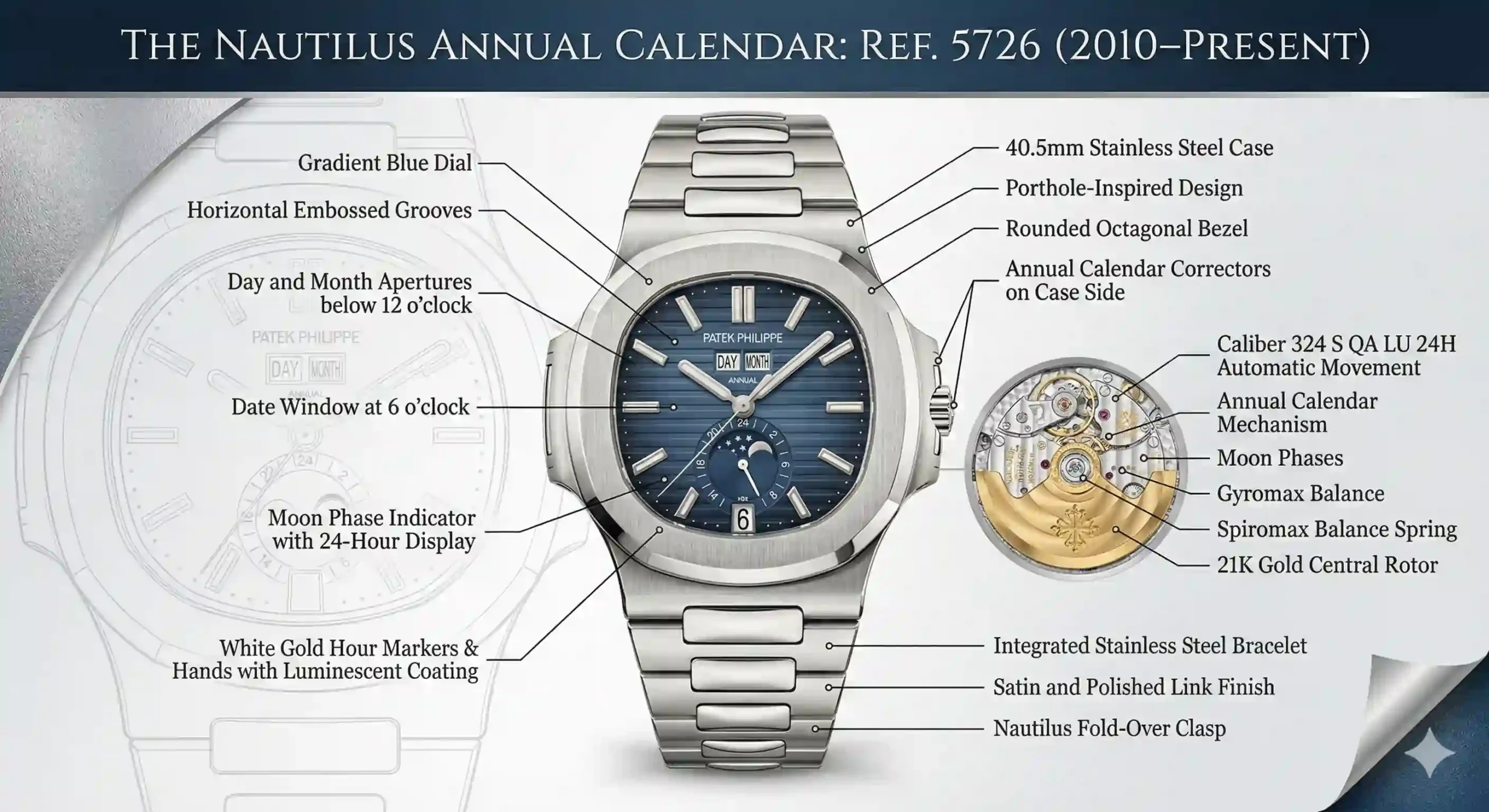
The 5726 features a slightly larger 40.5mm case (10–4 o’clock) with a height of 11.3mm, and a case back secured by lateral screws at the “ears”, similar to the chronograph 5980. It houses the self-winding caliber 324 S QA LU 24H/303, combining precision and functionality. Initially offered in steel with a dark grey gradient dial and leather strap, it expanded to include a steel bracelet in 2012, a white dial, and later, a classic blue gradient dial in 2019. Today, examples remain highly sought after, with a blue dial on bracelet fetching HKD 945,000 (~CHF 118,700) at Sotheby’s in 2022.
The Nautilus Travel Time Chronograph: Ref. 5990 (2014–Present)
In 2014, Patek Philippe unveiled the Ref. 5990A, combining a flyback chronograph and dual time function with an analogue date—making it one of the most technically impressive Nautilus models. While both complications existed elsewhere in Patek’s lineup, the 5990 masterfully integrated them into the iconic three-part Nautilus case without compromising its porthole-inspired design. Pushers were cleverly repositioned: chronograph buttons at 2 and 4 o’clock, a date corrector at 1 o’clock, and time zone adjusters hidden in the 9 o’clock “ear.”
The dual time mechanism, patented by Louis Cottier in 1959, uses two central hands—skeletonized for home time, solid for local time—adjustable forward or backward in one-hour increments, with day/night indicators for both zones. The analogue date moved to 12 o’clock, while the 60-minute chronograph counter sits at 6 o’clock, resulting in a clean, balanced dial.
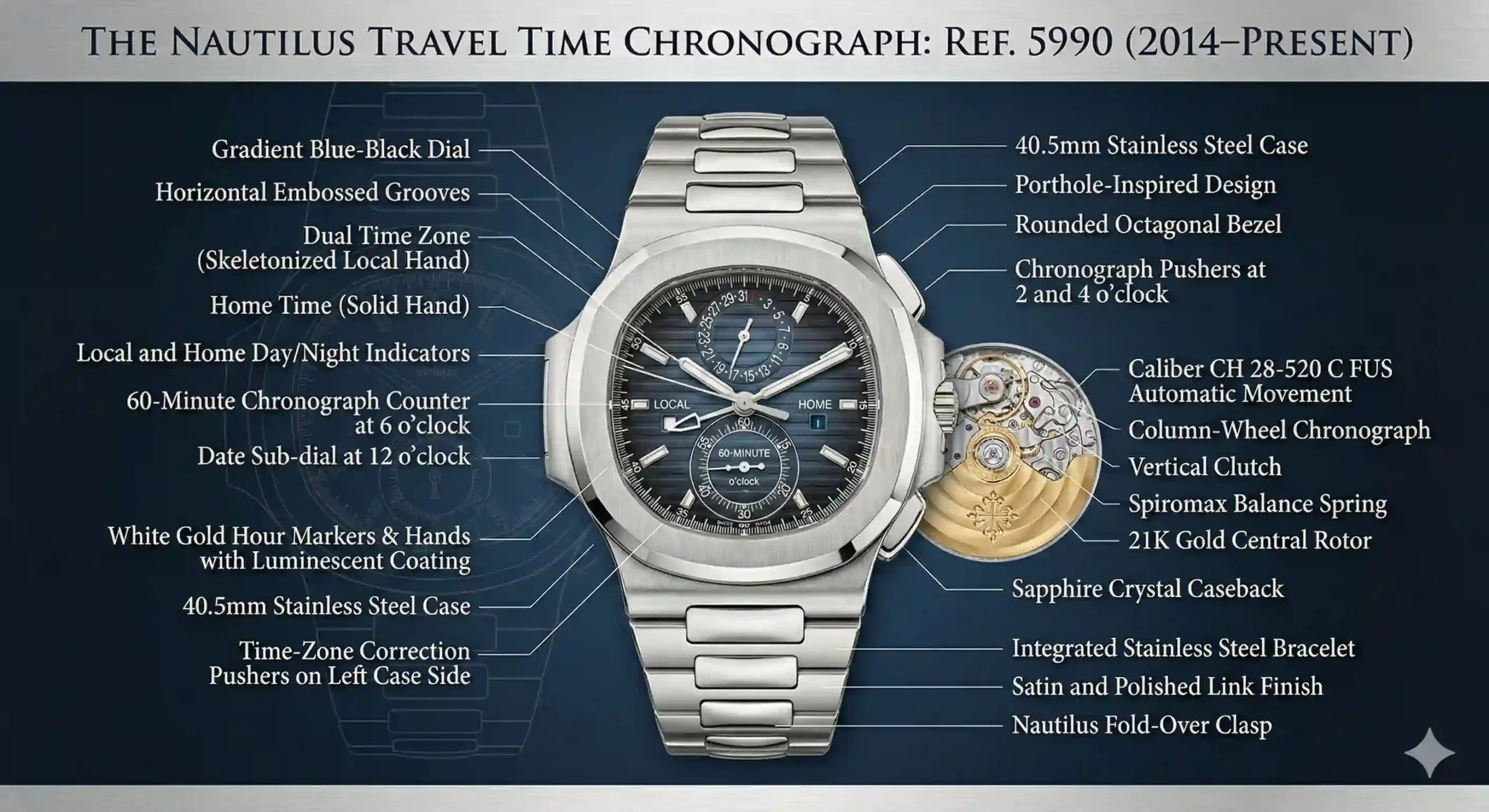
Measuring 40.5mm, the 5990 has been offered in stainless steel with a black gradient dial and rose gold with a blue gradient dial. Collectors prize this reference for its technical ingenuity and seamless integration of complications, with auction prices reaching EUR 126,000 (~CHF 120,100) for a 2015 steel example.
The Nautilus Perpetual Calendar: Ref. 5740 (2018–Present)
In 2018, Patek Philippe pushed the Nautilus to new heights with the Ref. 5740G, introducing the perpetual calendar, the brand’s most prestigious complication, into the collection. Built on the ultra-thin caliber 240, it achieves a remarkably slim 8.42mm case height, making it the thinnest Patek perpetual calendar ever.
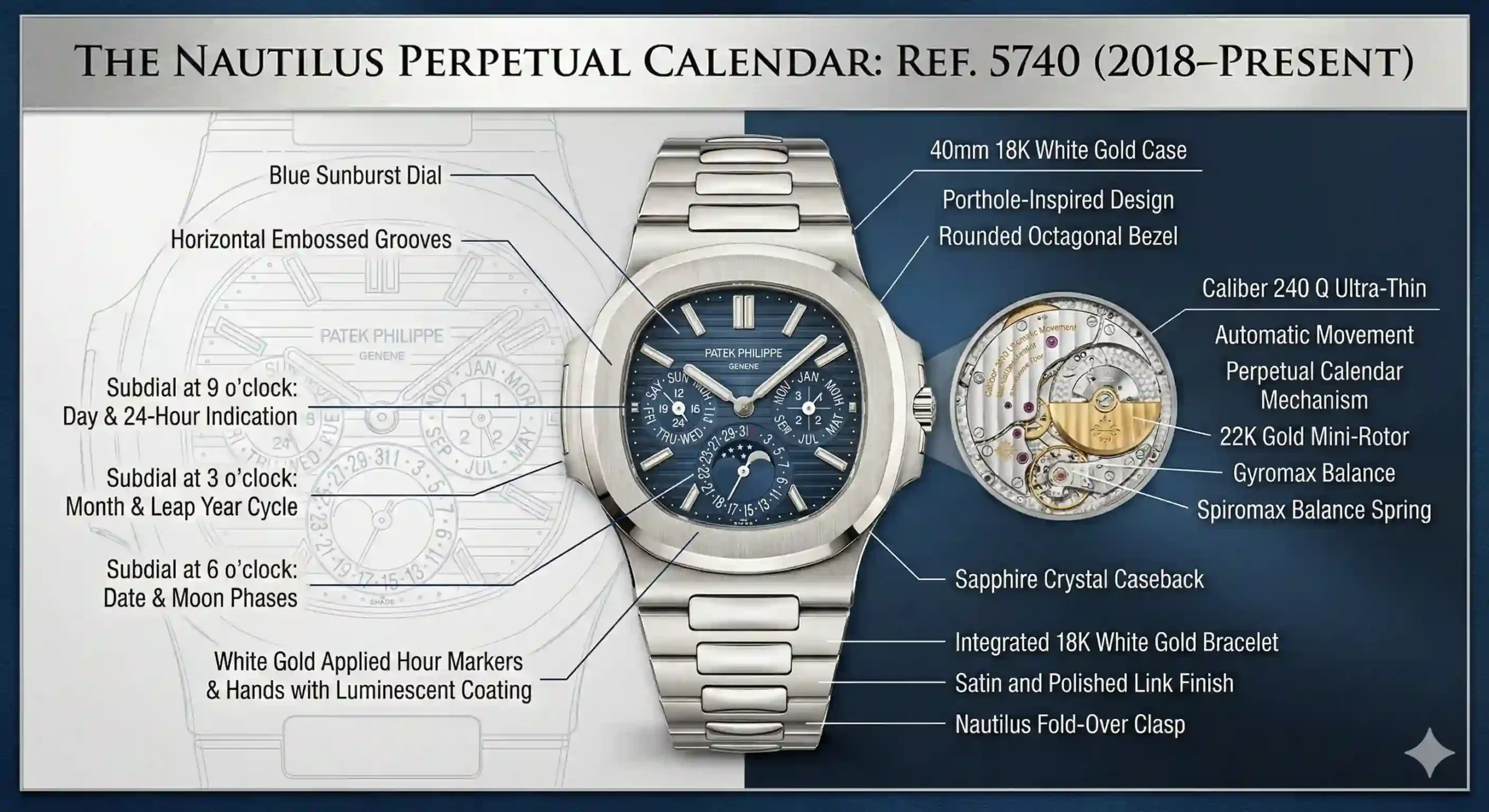
The watch features a 40mm three-part white gold case, a classic blue dial, and a case back secured by lateral screws at the ears, echoing the construction seen in the 5980 chronograph and 5726 annual calendar. Its traditional perpetual calendar relies on a grand lever and 48-month cam, combining classic horology with Nautilus’ sporty elegance. Today, examples of this highly coveted reference sell for HKD 2,016,000 (~CHF 253,200) at auction, reflecting its rarity and status among collectors.
Final Thoughts
So, after tracing the journey from the original 3700 Jumbo to the latest 5811 and perpetual calendar 5740, it’s clear: the Patek Philippe Nautilus isn’t just a watch—it’s a story of bold design, technical mastery, and timeless style. “Wow, that’s a lot of references!”—I hear you. But now, you can actually see why each model matters, what makes them unique, and how the evolution shaped the icons we admire today. Whether you’re hunting for your first Nautilus or simply marveling at the legacy, you now have the roadmap to understand the subtle details, the historic pivots, and the collector’s must-haves. So, next time someone asks, “Which Nautilus is the one to get?”—you’ll know exactly how to answer. And maybe, just maybe, you’ve spotted the watch that belongs on your wrist.