
History of Rolex | the Truth Beyond Crown
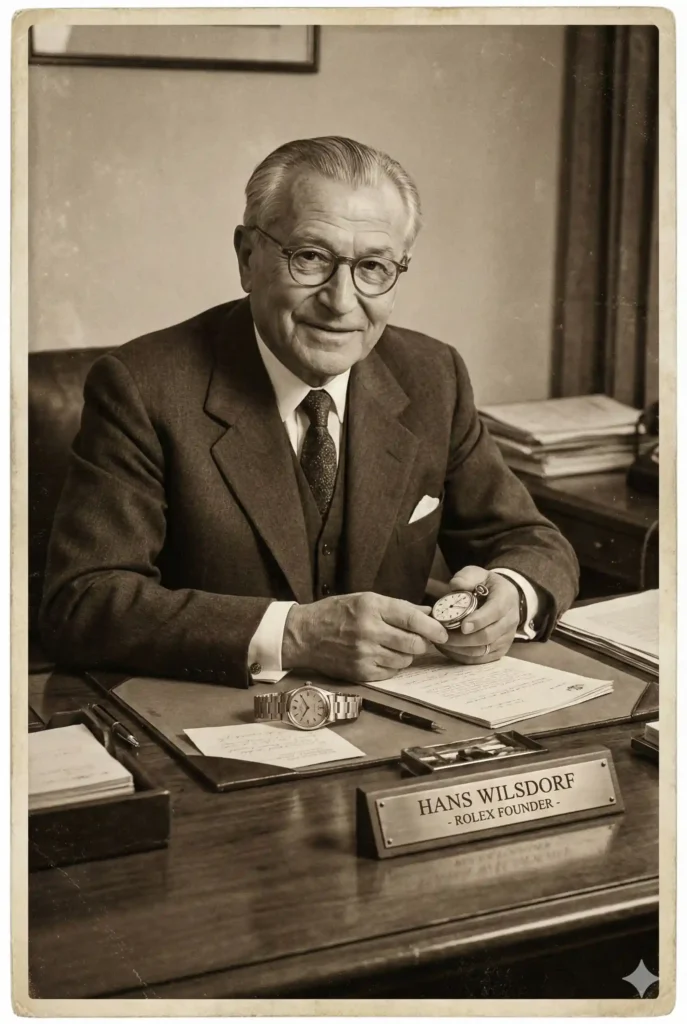
You see the famous Crown and think “wealth,” but have you ever wondered if it’s just clever marketing? Here is the truth: Rolex started in 1905 as a “crazy idea” by Hans Wilsdorf that everyone laughed at because they thought wristwatches were just fragile jewelry. He proved them wrong by building the indestructible “Oyster” and testing it on swimmers and explorers, not just models. Today, with over1.2 million watches sold yearly, Rolex isn’t just a status symbol—it is the result of a massive gamble that changed history. Let’s look past the hype to see how they really did it.
Hans Wilsdorf: The Visionary Behind the Crown
The London Origin: How a “Bad Idea” Became Legend
Did you know the world’s most famous Swiss watch didn’t actually start in Switzerland? It began in London in 1905 with a 24-year-old named Hans Wilsdorf who had a vision everyone else thought was crazy. Back then, “real men” carried pocket watches, and wristwatches were seen as inaccurate toys for ladies. But Hans bet everything on a different future. It started as “Wilsdorf & Davis,” later created the name “Rolex” in 1908—a word made up to be short, catchy, and easy to pronounce in any language. He then silenced his critics by winning the world’s first accuracy awards in 1910, proving that a watch on your wrist could be just as precise as a ship’s navigation tool.
What does the Rolex Mean

Here is a fun fact that stumps most collectors: “Rolex” isn’t a family name, and it doesn’t mean anything in French or German. So, where did it come from? Hans Wilsdorf claimed that while he was riding a horse-drawn bus in London, a “genie whispered ‘Rolex’ in his ear.” Whether you believe in genies or not, the name was genius. He wanted a word that was short, looked good on a watch face, and could be easily pronounced in any language. By 1919, he took this catchy name, moved the entire company to Geneva, and officially became Montres Rolex S.A., leaving England behind to conquer theSwiss watch world.
Innovation: The Birth of the “Tool Watch”
Why Your Watch is “Sealed”
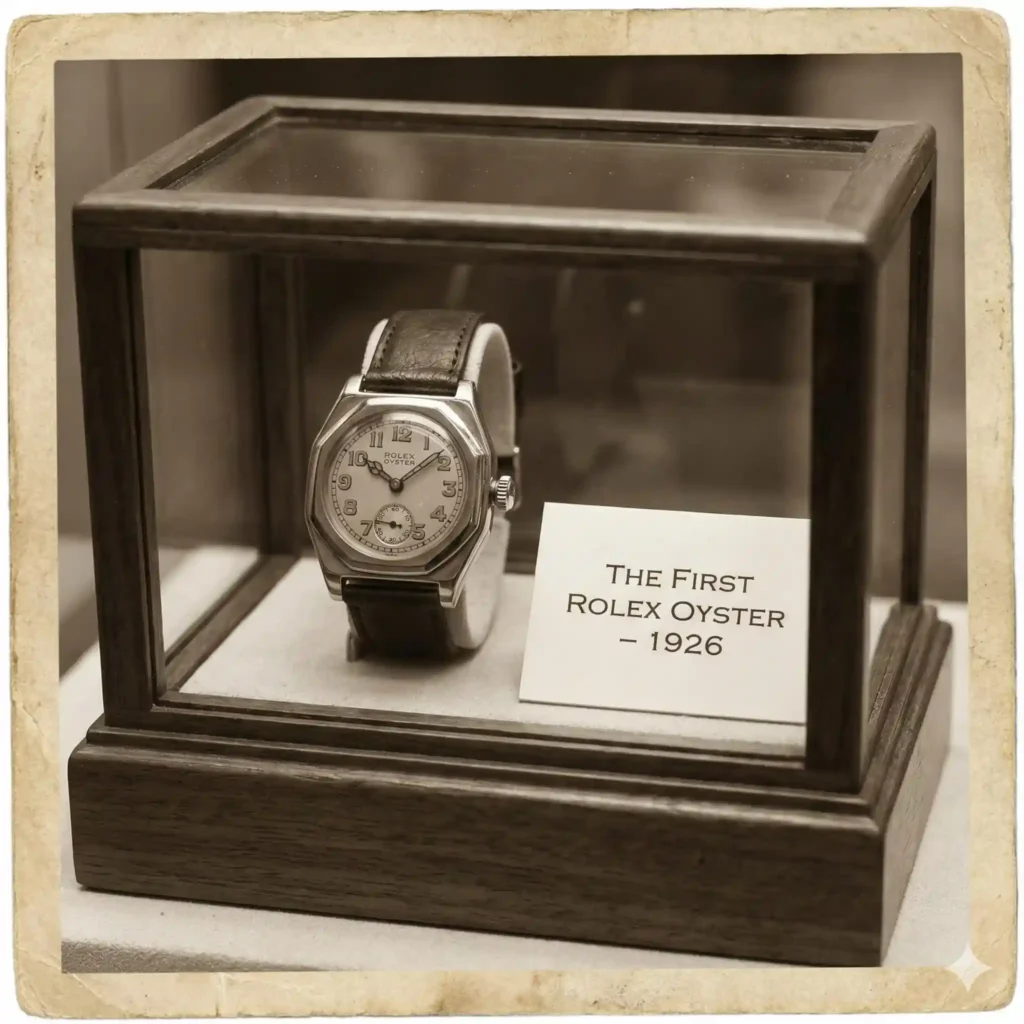
In the early 1920s, wristwatches were fragile. Dust and moisture ruined them instantly. If you wanted a watch that could handle real life, you were out of luck—until 1926.
Hans Wilsdorf didn’t just want a “durable” watch; he wanted one that was impenetrable. He bought a patent from two Swiss inventors (Paul Perregaux and Georges Peret) for a screw-down system that locked the case tight. He called it the “Oyster” because it clamped shut just like the shell of an oyster, protecting the pearl inside. This was the world’s first true waterproof watch, and it changed everything.
The “Channel Swim” Stunt
But here is the problem: Saying a watch is waterproof is easy. Proving it is hard. People were skeptical.
So, in 1927, Wilsdorf pulled off a legendary marketing stunt. He gave an Oyster watch to Mercedes Gleitze, a British professional swimmer, for her attempt to swim the English Channel. She wore it around her neck for over 10 hours in freezing, salty water.
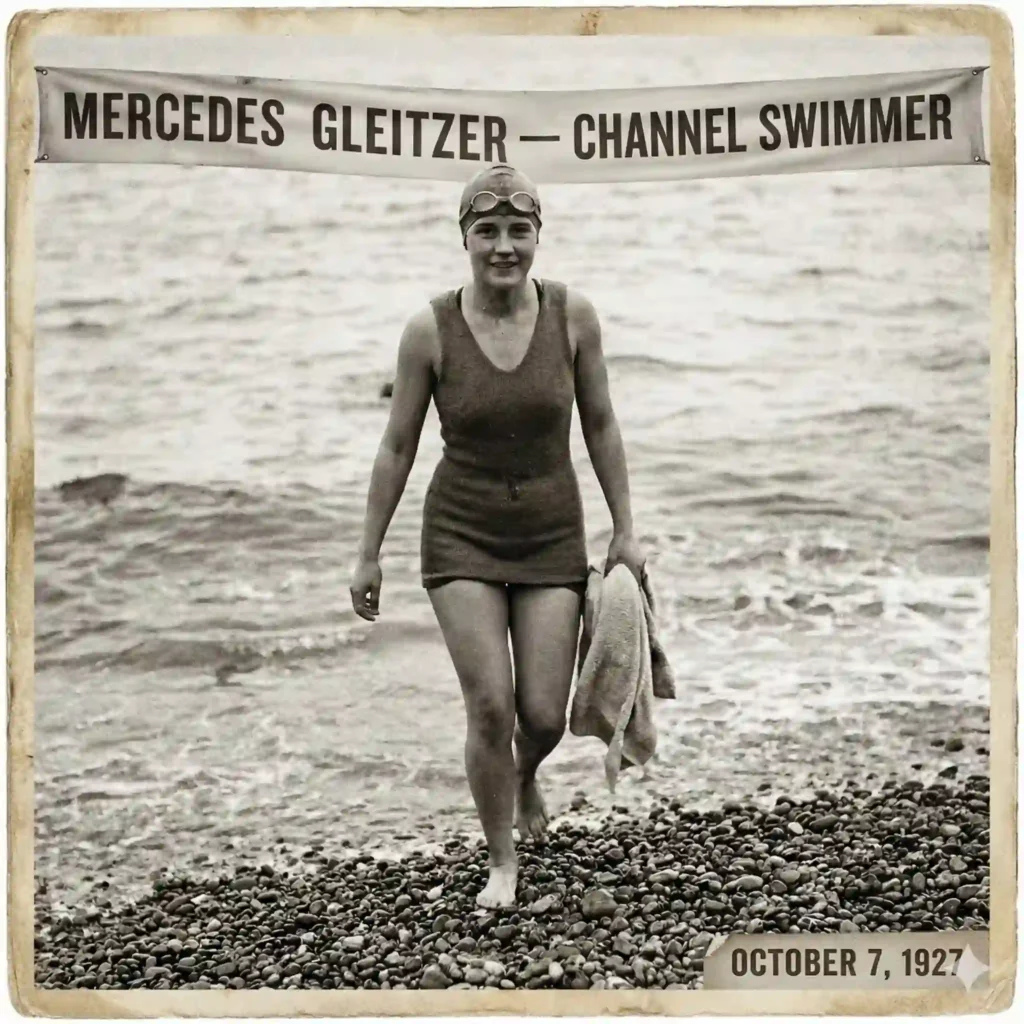
The result? When she emerged, the watch was still ticking perfectly. To make sure no one missed the news, Wilsdorf bought the entire front page of the Daily Mail and started displaying Rolex watches inside fish tanks in shop windows. The message was clear: If it can survive the ocean, it can survive your daily life.
The Submariner: Born for the Deep (1953)
That same year, Rolex turned its eyes to the ocean. They launched the Submariner, the first watch in history guaranteed waterproof to a depth of 100 meters (330 feet).
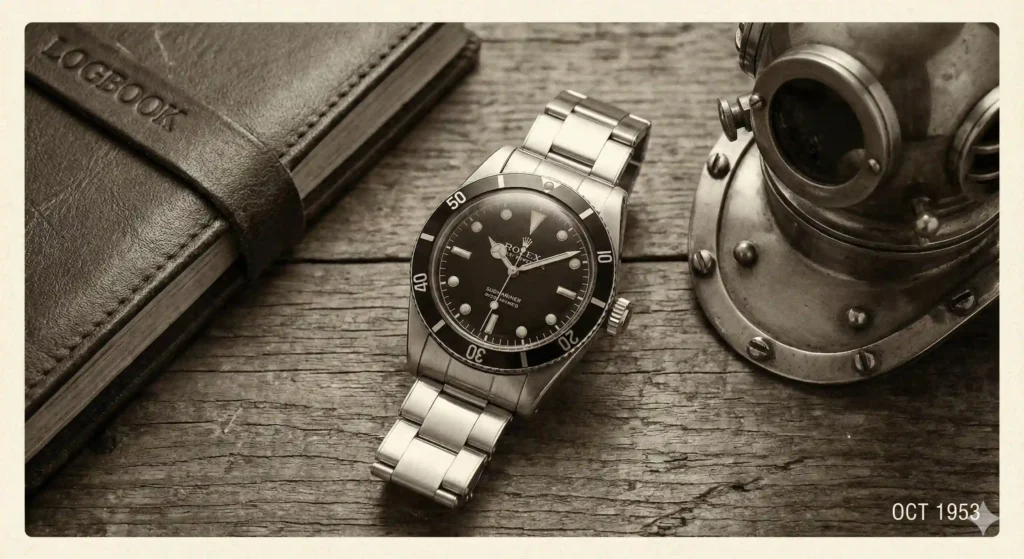
But Rolex didn’t just stop at “good enough.” To prove it, they strapped a special Rolex to the outside of a submarine (the Bathyscaphe) and sent it down to the bottom of the Mariana Trench—nearly 36,000 feet deep! When the sub came back up, the watch was still ticking perfectly. This engineering paved the way for the Submariner to become the ultimate diver’s tool.
The “Oyster Perpetual”: A Legendary Union
Here is a problem people faced back then: if you forgot to wind your watch in the morning, it stopped. Rolex fixed this in 1931 with a brilliant invention called the Perpetual Rotor.
Think of it as a hidden engine that feeds off your energy. It captures the natural motion of your wrist moving throughout the day and uses it to power the watch automatically. This meant you never had to worry about manually winding it again. It was the birth of the modern “automatic” watch—a machine that lives as long as you keep moving.
The Day-Date Automatic Advancements
First, in 1945, Rolex changed the game with the Datejust, the first self-winding watch to automatically display the date in a window. But in 1956, they went even bigger with the Day-Date, the first watch to spell out the full day of the week. It became the ultimate symbol of power when U.S. President Lyndon B. Johnson started wearing one. The specific three-piece bracelet on this watch is even officially called the “President bracelet.” If you see one on a wrist today, it still sends the same message: This person is in charge.
The Zenith Era: Daytona Legacy
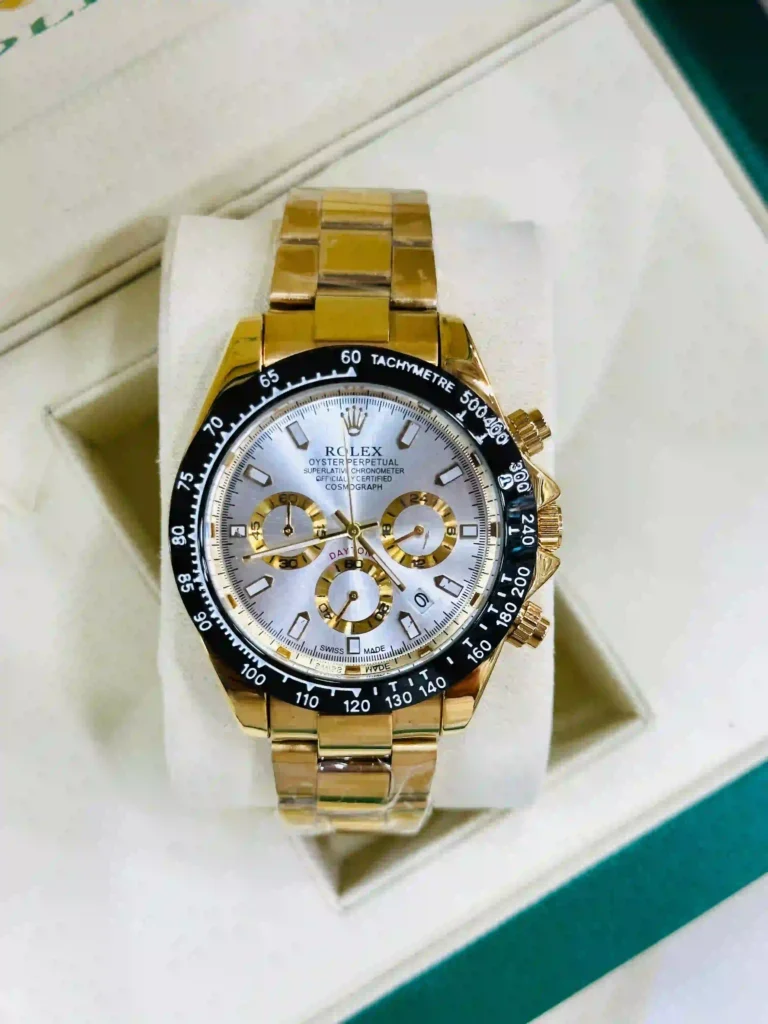
It wasn’t designed to be pretty; it was designed to be fast. It featured a tachymetric scale on the bezel, which acted like a speedometer on the wrist, allowing drivers to measure their speed up to 400 miles per hour.
The “Paul Newman” Effect But why is this watch so legendary today? You can thank Hollywood superstar and racer Paul Newman. He loved the watch so much he wore it every day. The specific version he wore (with “exotic” dials) became known as the “Paul Newman Daytona.” Today, these are some of the most expensive and hunted vintage watches in the world. If you find one in an attic, you’ve basically found a winning lottery ticket.
From the Top of the World
You might think of Rolex as a “suit and tie” watch, but its reputation wasn’t built in a boardroom—it was built in the most dangerous places on Earth.
In 1953, Rolex wanted to prove their watches were indestructible. So, they equipped the expedition of Sir Edmund Hillary and Tenzing Norgay as they climbed Mount Everest. While the climbers battled freezing temperatures and thin air, the Rolex Oyster Perpetual kept perfect time. This legendary feat inspired the launch of the Rolex Explorer, a watch designed specifically for people who push human limits.
From Tools to Icons: The Hollywood Shift
So, how did a tool for climbers and divers become a symbol of style? You can thank James Bond.
When Sean Connery wore a Submariner in the early 007 movies, the world realized that a tough watch could also look elegant with a tuxedo. From Paul Newman’s race-worn Daytona to the wrists of Presidents, Rolex transitioned from a pure tool to a global icon. Today, every Rolex is tested to be a “Superlative Chronometer” (meaning it is insanely accurate), proving that while they look good on the red carpet, they are still built for the wild.
Final Thoughts
More Than Just a Watch So, what started in 1905 as a “ridiculed idea” by an orphan in London has transformed into the ultimate symbol of human achievement. Hans Wilsdorf didn’t just build a brand; he proved the world wrong by creating the waterproof “Oyster” and the self-winding “Perpetual” engine—innovations that survived the English Channel, the peak of Everest, and the bottom of the Mariana Trench. Whether it’s the racing spirit of the Daytona or the rugged history of the Submariner, owning a Rolex means you aren’t just wearing jewelry; you are wearing a machine built to outlast you. Ready to find the one that fits your story? Explore our certified collection today and wear the legend yourself.
Very useful and informative